lighting · Sep 09, 2026
Lighting a Room in 1958 Terms
One ceiling light was the old way. The postwar way was lamps at different heights, a pendant that hid the bulb and a warm pool of light wherever you sat.
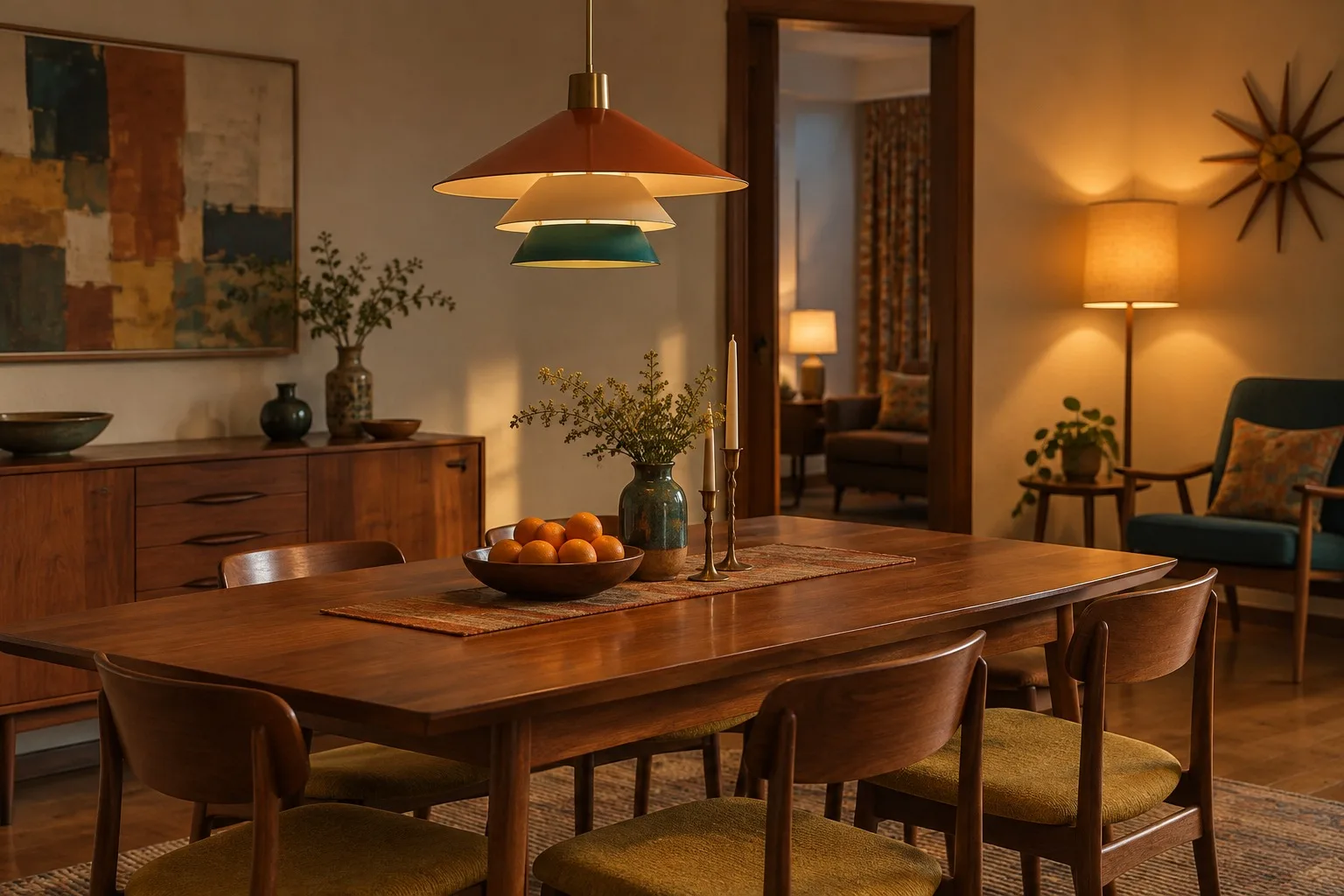
Walk into a room at night and notice where the light comes from. In most homes, it comes from above: a single bright fitting in the middle of the ceiling that floods everything equally and shadows nothing.
The postwar approach was the reverse. You didn't light the room. You lit the places in it.
The lesson of the pendant
Take the PH 5, the layered pendant that the Danish designer Poul Henningsen designed in 1958 and Louis Poulsen still makes. It's a stack of shades, each one shaped to hide the bulb from every angle you are likely to look from while bouncing the light outward and down. Nobody who sits beneath one ever sees a glaring filament.
That is the principle. Hide the source. Shape the glow. Make the light feel like a material, soft, directed and warm, and not like a fact.
You don't need that lamp, or any famous lamp, to follow the lesson. A drum shade over a bare bulb does the same work for a fraction of the price. What matters is that you cannot see the glare.
Three heights
A well-lit mid-century room has three layers.
High. A pendant or a ceiling-mounted spot, over the table or the entrance. It provides the main pool and the sense of a centre.
Middle. Lamps on sideboards and tables, at about the height of your shoulder when you are seated. These do most of the work in the evening.
Low. A floor lamp in a corner, or a small lamp on the floor behind a plant. This is the glow that makes the room feel deeper at night.
If you light only the top, the room is flat. Add the middle and it has a body. Add the low and it has a mood.
Choose the bulb carefully
Warm, not white. Look for a bulb described as warm white, and avoid anything that calls itself cool or daylight for living rooms. The colour of the light affects the colour of the wood, and teak under a cold bulb goes grey and sullen. Under a warm one, it glows.
Dimmers are the cheapest luxury in the house. A dimmer on the pendant means you can drop the whole room into evening in one movement.
Where people go wrong
Too many spotlights in a row, which make a runway. A lampshade that sits too high, so the bulb shows from the sofa. A lamp on the dining table that is too tall, so you cannot see across to the person opposite. A single bright light beside the television, which makes the screen hard to watch.
Make a map. Mark where you sit, where you read, where you eat. Put a light source near each, and nowhere else.
One experiment
Tonight, switch off the ceiling light. Turn on two lamps at different heights. Sit down. Wait five minutes.
You will have the 1958 living room. Then on to the room-by-room tour, where all of this is put to work in an invented house: the Alder Lane house.
No comments yet
Comments are open. Have a thought or a question? Share it below.