sideboard · Sep 17, 2026
A Sideboard Buying Guide
A sideboard is the hardest-working piece in the house. Here is how to read the joints, test the runners and decide what you actually need before you fall in love.
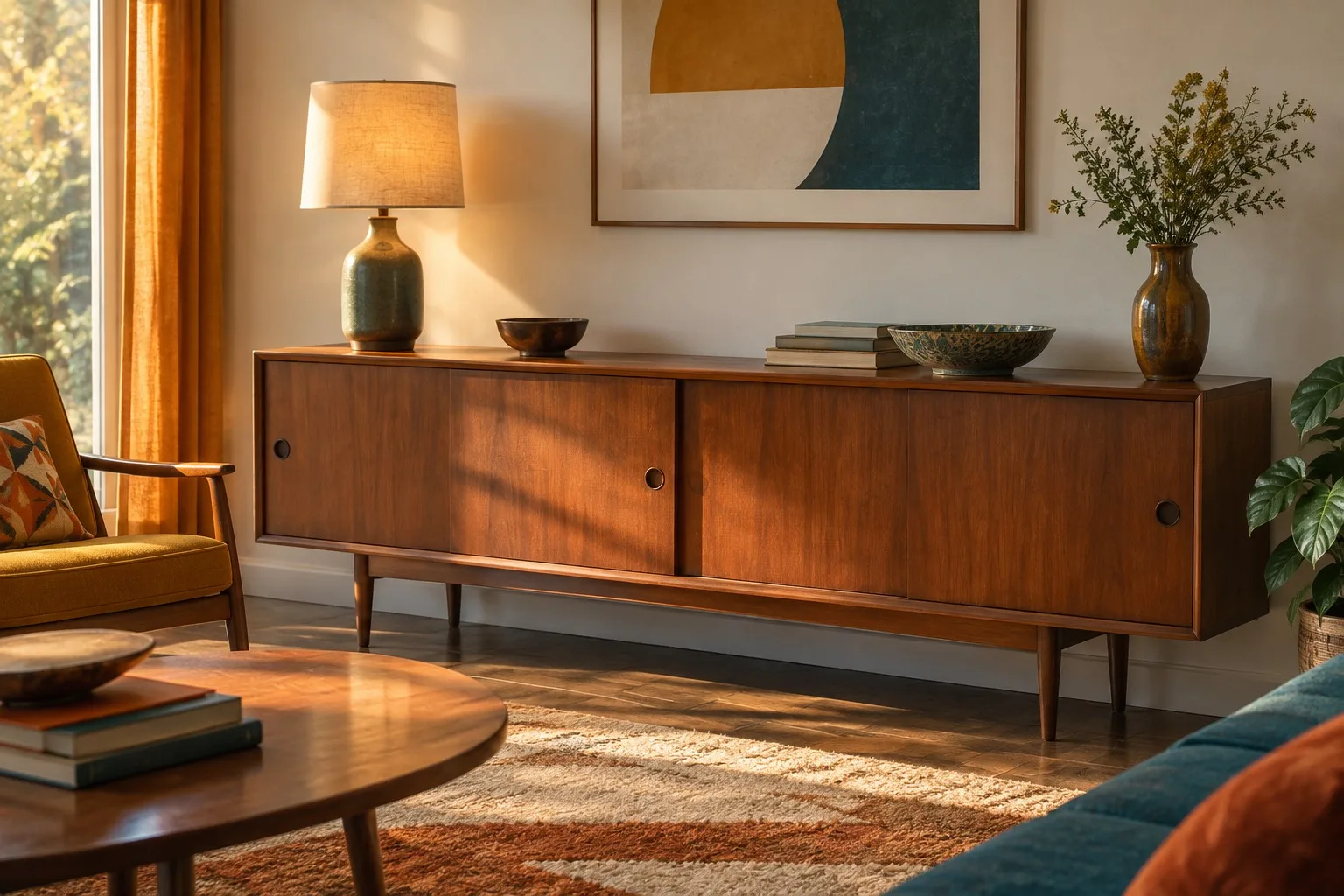
A sideboard hides the things you don't want to look at and displays the things you do. It carries lamps, plants, records and a bowl for keys. It lives in the same spot for years. Pick the wrong one and you will walk past it every day, a little annoyed.
Here is the checklist I wish I'd had for my first.
Start with the wall
Before you open a single listing, measure. The width of the wall, the clear height under any window, the gap between the radiator and the corner. Then the depth you can spare. Many mid-century sideboards are shallow, which suits a hallway. A deeper one will swallow a small room.
Write the numbers down. Take the tape measure with you when you go to look at a piece. It is amazing how often a sideboard is a few centimetres wider in life than in the photograph.
Checking the piece
Inside the thing
Open every door, pull every drawer. A good sideboard should move quietly, with no catching, no wobble and no stubborn corner. Sliding doors run in a groove or on a track; check that they glide the full length and don't jump out.
Look at the back. A solid back panel is a good sign. A thin sheet of hardboard is not a flaw in itself but it tells you what the maker saved on.
Check the interior for smell. A damp cupboard or an old cigarette smell is hard to remove and spreads to everything you store in it.
Joints and legs
Pull a drawer out and look at the corners. Dovetails, where the two pieces lock like fingers, mean good construction. Stapled or glued butt joints are a warning.
Push down on the top, then wobble the piece gently from side to side. Tapered legs look elegant but a loose one will have been there for years and will be a nuisance to repair. A small wobble can be fixed with a glue and a clamp. A split in a leg at the joint is a bigger job.
Wood or veneer
A sideboard in solid wood is heavier and easier to repair. A veneered one can be just as good, but check the edges for chips and lifting, and look for water rings on the top. Ask the seller if it has been refinished. A good refinish is fine; a heavy-handed one has lost the patina and sometimes the veneer.
The questions to ask
What did you keep in it?
Has any part been replaced?
How was it stored, and for how long?
Can I see the underside?
What is the lowest price you'd accept? Nobody is offended by this one.
What to spend
Set your ceiling before you go. A sideboard is a piece of furniture, not an emotional investment, and the market is full of tempting extras. A good one can be found at several budgets, but a plain one in good condition beats a showy one in poor repair every time.
When you've found it, give it room to breathe. The next piece shows a whole house where everything has a place: the Alder Lane house, room by room.
No comments yet
Comments are open. Have a thought or a question? Share it below.