kitchen · Aug 24, 2026
The Atomic-Age Kitchen, Honestly
Boomerang laminate, a pastel range and a clock shaped like a starburst. What the postwar kitchen got gloriously right, what it got wrong, and what to keep in 2026.
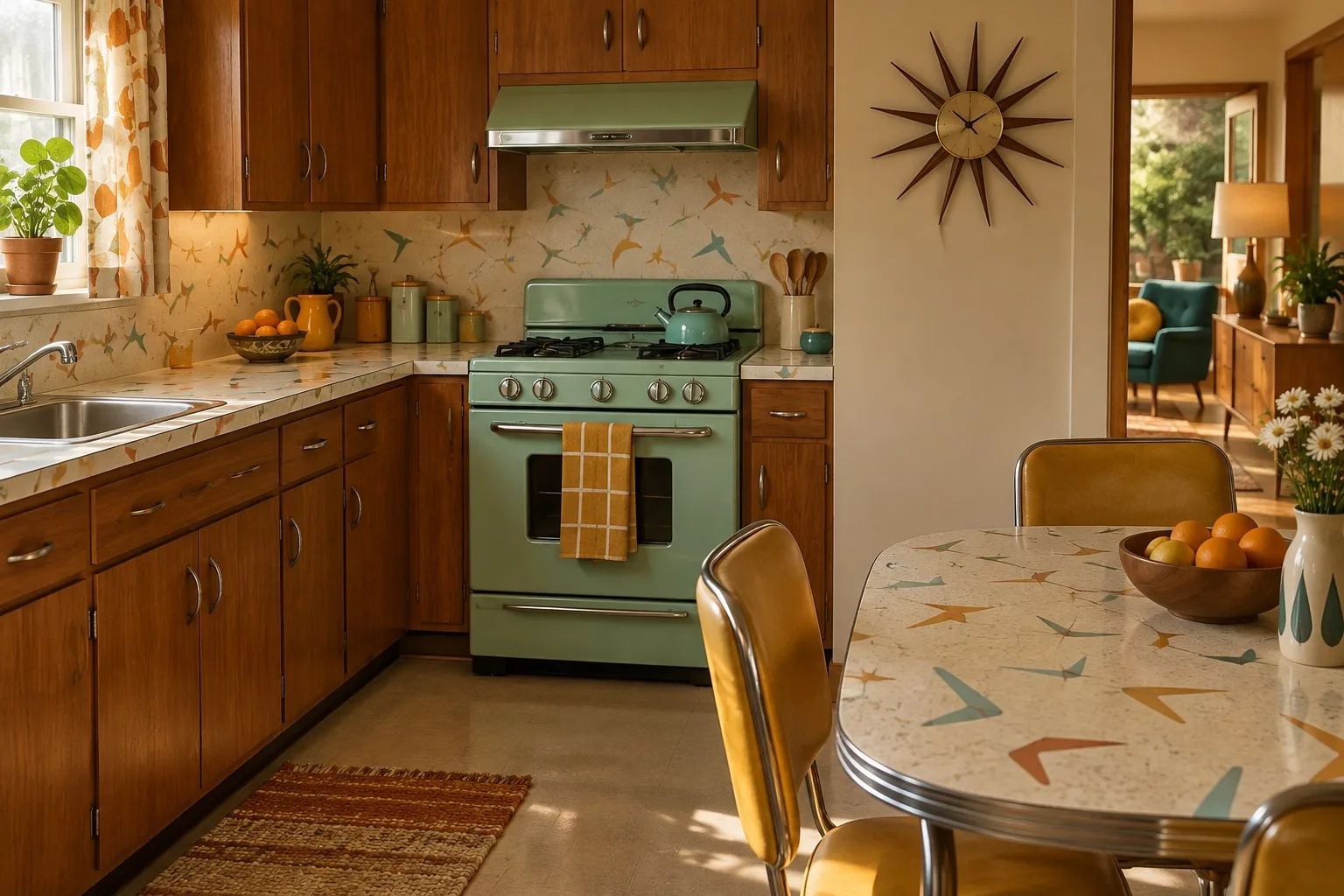
There is a kind of person who walks into a 1950s kitchen and says, I could live here. I am that person. I also have to confess I would not cook in the original for longer than a week.
Here, then, an honest accounting of the atomic-age kitchen: what to love, what to leave and what to copy.
What it got right
The layout is the quiet triumph. The best postwar kitchens were planned around movement. The cooker, the sink and the fridge sat in a tight, efficient triangle, with a counter between each. You could turn on one heel and reach everything. Cupboards ran to the ceiling or stopped at a deliberate line, never somewhere in between.
Then the colour. Mint, butter yellow, powder blue, a soft coral. Nobody was afraid of a coloured appliance, and the result is a room with a mood. A mint refrigerator makes you smile before you open it.
And the surfaces. Laminate with a pattern, a boomerang or a flecked confetti, was meant to be hard-wearing and cheerful, and in a good original it still is. You can wipe it, you can scrub it, and it forgives the occasional hot pan better than it deserves to.
What it got wrong
Storage. Original kitchens were designed for fewer things. No room for a food processor, a coffee machine, a rack for seven kinds of olive oil. Drawers were shallow, handles were tiny, and the corner cupboards were deep, dark and unreachable.
Insulation and ventilation, too. A lovely pastel range is not much use if the extractor is a hole in the wall with a fan in it. If you inherit a period kitchen, the first thing to improve is air.
And the lighting, which usually consisted of a single ceiling fitting. We will come back to that.
What to keep
Keep the colour. A single appliance in a bold pastel will do more for a room than any amount of beige. Keep the triangle. Keep the clean lines, the lack of fuss, the cupboards without ornament.
Keep, too, the sense of play. The atomic-age kitchen is the only room in the house where a clock shaped like a molecule seemed a reasonable idea. Let one bit of silliness in.
What to skip
Skip the all-in recreation. A kitchen that is perfectly period usually feels like a film set. People live in the room, and the room has to make allowances: a dishwasher, an induction hob, a socket for the kettle. Hide them behind a panel if you must, but have them.
A practical plan
If you love this look and have a budget:
Decide the colour of one appliance or one wall and make it the hero.
Choose a laminate or a good imitation for the main worktop, in a flecked pattern, not a plain one.
Replace the ceiling light with two or three sources at different heights.
Fit a modern extractor behind a retro hood.
Hang the clock last, when everything else is settled.
And now the surface that goes in the dining room, the one that needs a little patient care: teak, without the fuss.
No comments yet
Comments are open. Have a thought or a question? Share it below.